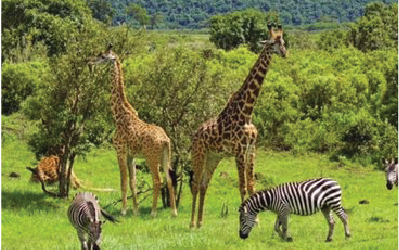
Safaris Detail Page
Tailor-made wildlife Safaris
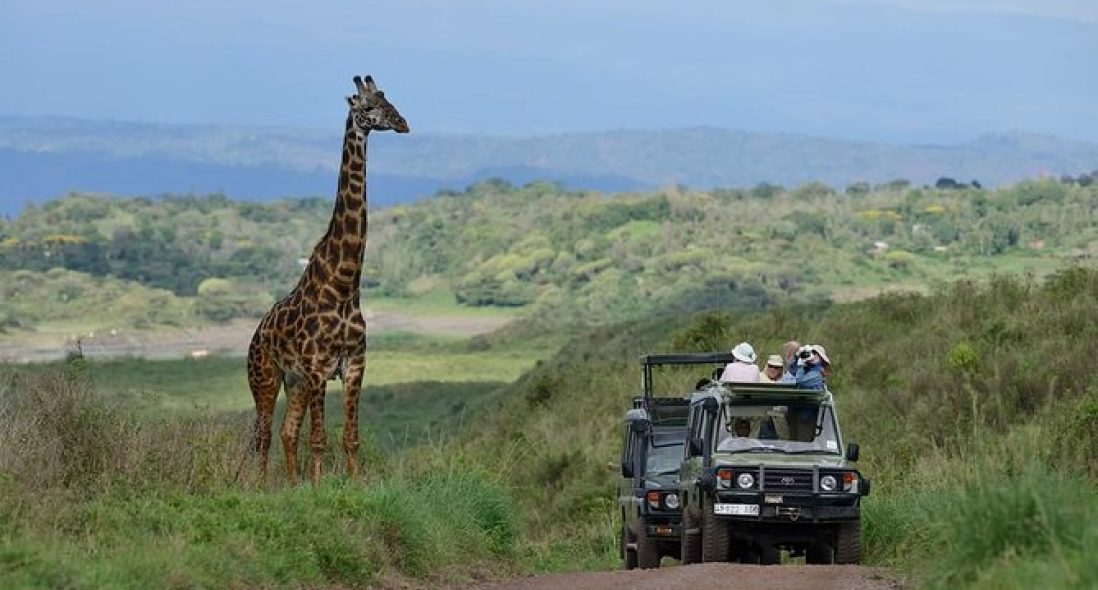
Tanzania is one of the world's greatest safari destinations. It's game viewing experiences is widely regarded as the best in Africa. Tanzania is well known for its rich culture, and diverse landscapes, the country boasts a wildlife population that is unparalleled on the African continent. With 5,700 square miles of plains stretching as far as the eye can see, the Serengeti is home to one of the most diverse wild animal populations on Earth, come to Africa's roof top and the world's highest free standing mountain – Mount Kilimanjaro, visit the Ngorongoro Crater - the largest crater in the world, and a vast amphitheatre teeming with game, then you can finish you holiday on the spice island of Zanzibar.
Serengeti National Park
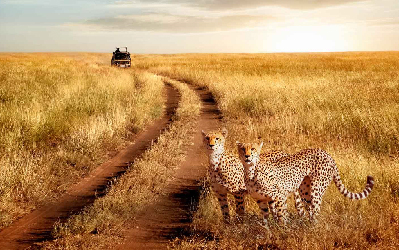
Tanzania's oldest and most popular national park, also a world heritage site and recently proclaimed a 7th world wide wonder, the Serengeti is famed for its annual migration, when some six million hooves pound the open plains, as more than 200,000 zebra and 300,000 Thomson's gazelle join the wildebeest’s trek for fresh grazing. Yet even when the migration is quiet, the Serengeti offers arguably the most scintillating game-viewing in Africa: great herds of buffalo, smaller groups of elephant and giraffe, and thousands upon thousands of eland, topi, kongoni, impala and Grant’s gazelle. The spectacle of predator versus prey dominates Tanzania’s greatest park. Golden-maned lion prides feast on the abundance of plain grazers. But there is more to Serengeti than large mammals. Gaudy agama lizards and rock hyraxes scuffle around the surfaces of the park’s isolated granite koppies. A full 100 varieties of dung beetle have been recorded, as have 500-plus bird species, ranging from the outsized ostrich and bizarre secretary bird of the open grassland, to the black eagles that soar effortlessly above the Lobo Hills.
Mikumi National Park
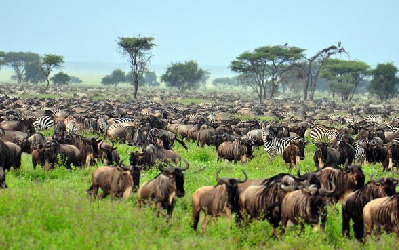
Mikumi National Park abuts the northern border of Africa's biggest game reserve - the Selous – and is transected by the surfaced road between Dar es Salaam and Iringa. It is thus the most accessible part of a 75,000 square kilometre (47,000 square mile) tract of wilderness that stretches east almost as far as the Indian Ocean. The open horizons and abundant wildlife of the Mkata Floodplain, the popular centrepiece of Mikumi, draw frequent comparisons to the more famous Serengeti Plains. Lions survey their grassy kingdom – and the zebra, wildebeest, impala and buffalo herds that migrate across it – from the flattened tops of termite mounds, or sometimes, during the rains, from perches high in the trees. Giraffes forage in the isolated acacia stands that fringe the Mkata River, islets of shade favoured also by Mikumi's elephants..
Ruaha National Park
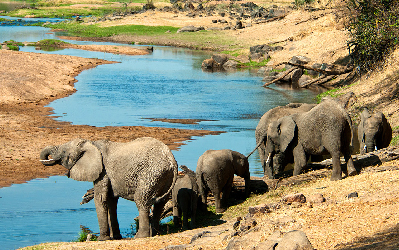
The game viewing starts the moment the plane touches down. A giraffe races beside the airstrip, all legs and neck, yet oddly elegant in its awkwardness. A line of zebras parades across the runway in the giraffe's wake. In the distance, beneath a bulbous baobab tree, a few representatives of Ruaha's 10,000 elephants - the largest population of any East African national park, form a protective huddle around their young. Second only to Katavi in its aura of untrammelled wilderness, but far more accessible, Ruaha protects a vast tract of the rugged, semi-arid bush country that characterises central Tanzania. Its lifeblood is the Great Ruaha River, which courses along the eastern boundary in a flooded torrent during the height of the rains, but dwindling thereafter to a scattering of precious pools surrounded by a blinding sweep of sand and rock.
Mount Kilimanjaro
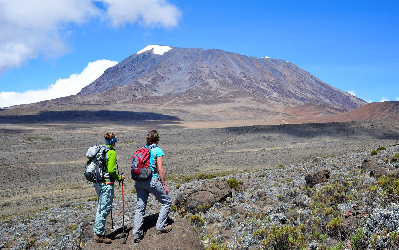
Mount Kilimanjaro (/ˌkɪlɪmənˈdʒɑːroʊ/)[4] is a dormant volcano located in Kilimanjaro Region of Tanzania. It has three volcanic cones: Kibo, Mawenzi, and Shira. It is the highest mountain in Africa and the highest single free-standing mountain above sea level in the world: 5,895 m (19,341 ft) above sea level and about 4,900 m (16,100 ft) above its plateau base. It is the highest volcano in Africa and the Eastern Hemisphere. Kilimanjaro is the fourth most topographically prominent peak on Earth. It is part of Kilimanjaro National Park and is a major hiking and climbing destination. Because of its shrinking glaciers and ice fields, which are projected to disappear between 2025 and 2035, it has been the subject of many scientific studies.
Tarangire National Park
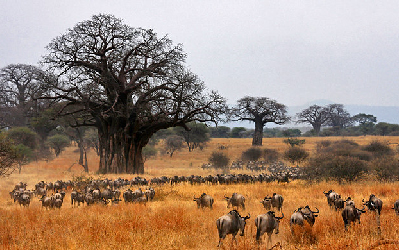
Herds of up to 300 elephants scratch the dry river bed for underground streams, while migratory wildebeest, zebra, buffalo, impala, gazelle, hartebeest and eland crowd the shrinking lagoons. It's the greatest concentration of wildlife outside the Serengeti ecosystem - a s morgasbord for predators – and the one place in Tanzania where dry-country antelope such as the stately fringe-eared oryx and peculiar long-necked gerenuk are regularly observed. During the rainy season, the seasonal visitors scatter over a 20,000 sq km (12,500 sq miles) range until they exhaust the green plains and the river calls once more. But Tarangire's mobs of elephant are easily encountered, wet or dry. The swamps, tinged green year round, are the focus for 550 bird varieties, the most breeding species in one habitat anywhere in the world.
Other Safaris
- Lake Manyara Park ok
- Ngorongoro Crater ok
- Aberdare Samburu Lake Nakuru Masai Mara ok
- Days Tanzania Zanzibar Bush Beach Luxury ok
- Days Wildlife & Bushmen Adventure ok